 Sobhan's Portfolio
SUMO Bot
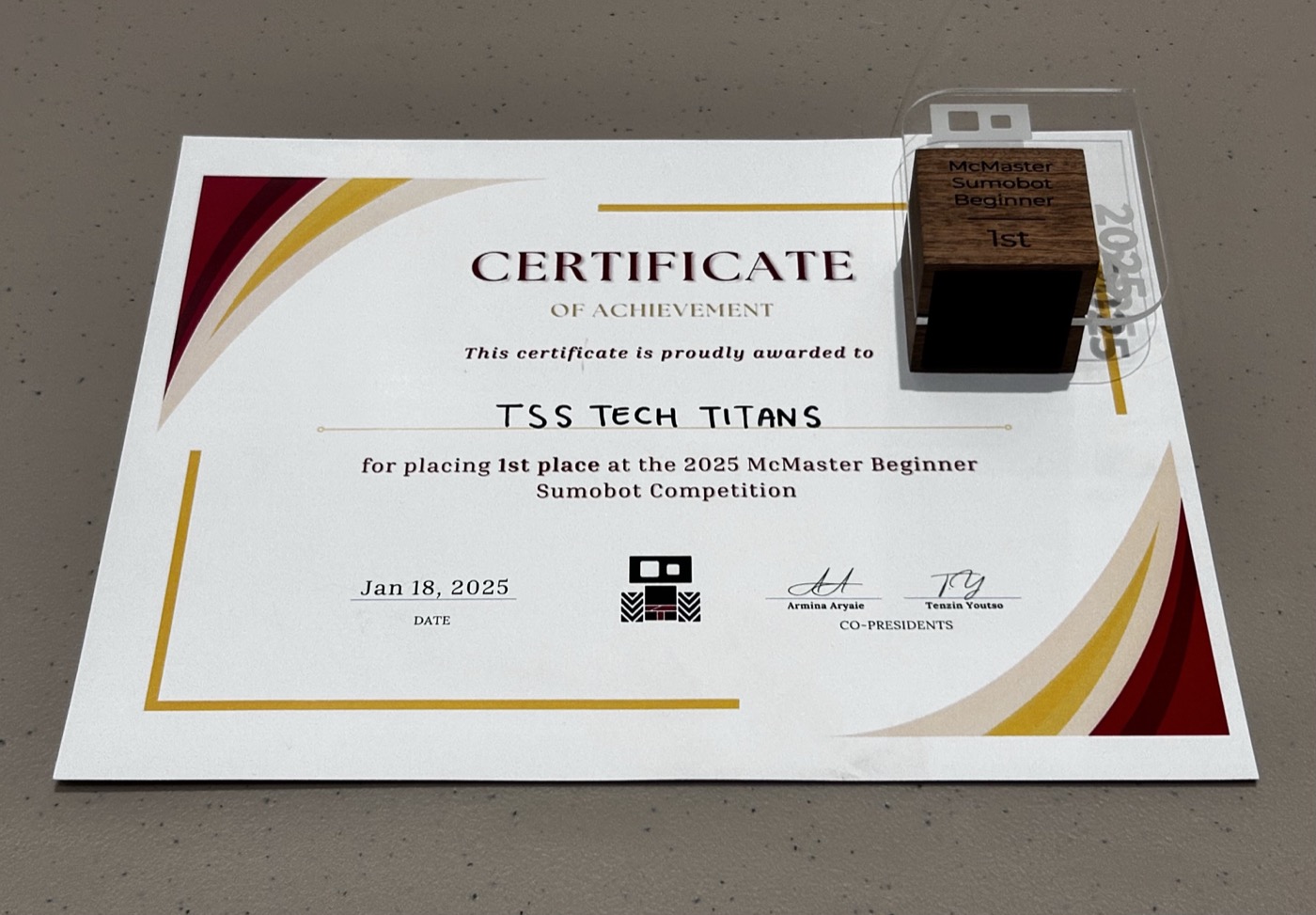
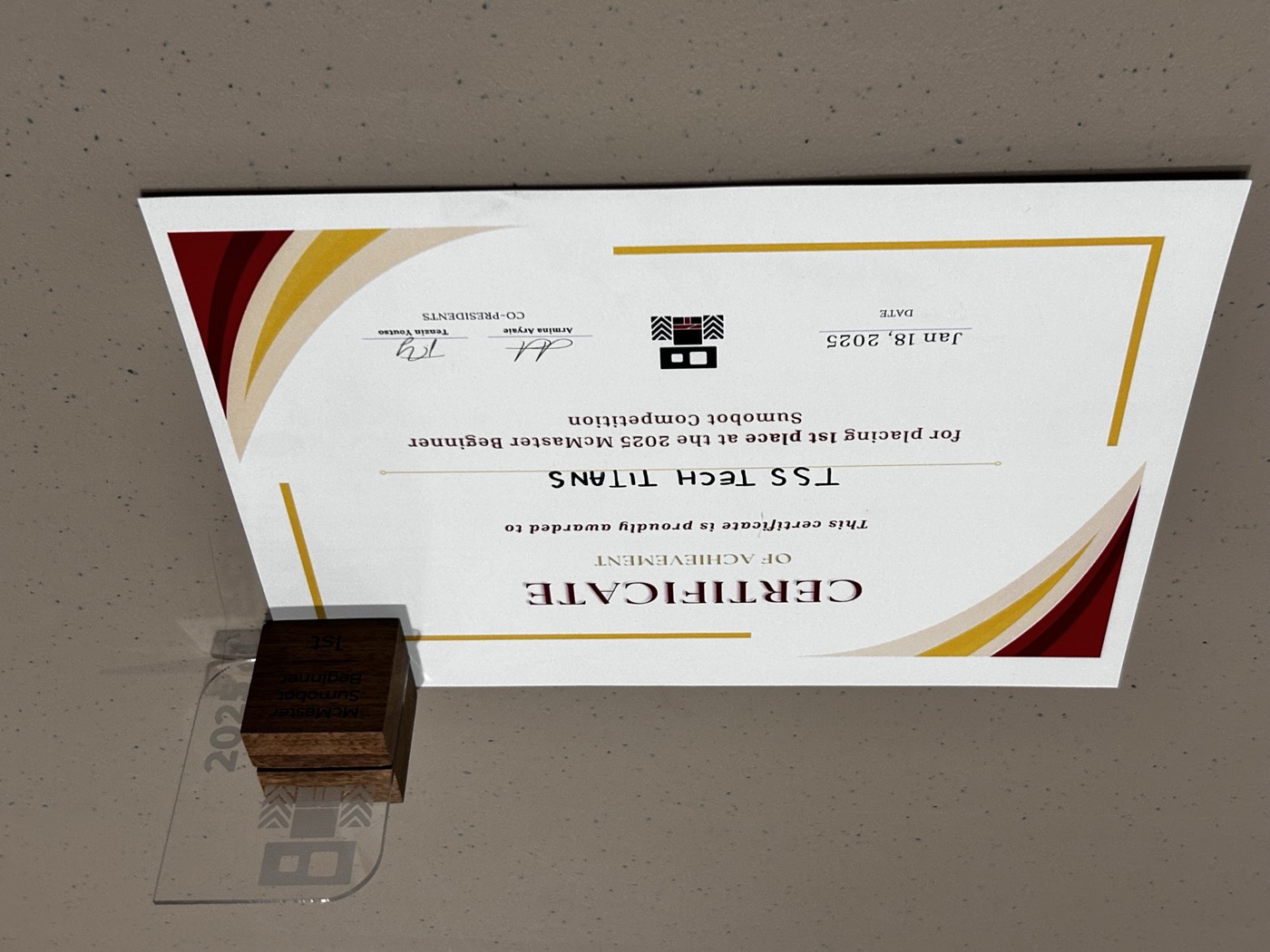
A low-profile robot that placed 1st out of 30+ teams at the McMaster SUMO Bot competition.
Overview
- Context
- As vice president and lead builder of my high school robotics club, I led our robot for the beginner class of the McMaster SUMO Bot competition. Robots must be fully autonomous, fit in 10 by 10 cm, weigh at most 500 g, and try to push each other out of a 77 cm black ring with a white border.
- Action
- I designed the robot in SolidWorks and Fusion 360 around a low steel wedge with a 3D-printed front end, and wrote the control logic in C++: stay inside the ring, find the opponent, and push.
- Result
- We placed 1st out of 30+ teams.
- Learning
- In a robot this small, every part placement is a tradeoff, and a simple, rigid design that never fails beats a clever one that sometimes does.
What I did
- Achieved 1st place out of 30+ teams at the McMaster SUMO Bot competition
- Designed robots using SolidWorks and Fusion 360, and wrote control logic in C++
- Designed 3D-printed chassis and custom mounting brackets to optimize weight distribution
- Led build sessions, mentored junior members, and managed team competition logistics
Engineering decisions
- Why a wedge. The idea came from robot fighting shows I watched as a kid: the robot I remember winning most was a wedge with a spinning blade. Weapons were not allowed here, but the wedge shape kept us very low to the ground, which made us hard to push out of the ring.
- A printed front end. The 3D-printed front end gave an even lower leading edge, so we could get under opponents and topple them or push them out more easily. The rules also ban edges sharp enough to damage the ring or other robots, so the edge had to be low without being sharp.
- Fitting everything in. With a 10 by 10 cm footprint, the motors, battery, and board had very few places they could go. The chassis and brackets were designed around those parts to keep the center of gravity low.
How it fights
- Staying in the ring. A light sensor at the very front watches the floor. When it sees anything that is not black, the robot backs up and turns about 45 degrees. Because the sensor is at the front, it triggers before the rest of the robot leaves the ring.
- Finding the opponent. An ultrasonic sensor points the robot toward the closest object while it stays inside the ring.
- Pushing. A push sensor on the front tells the robot it has made contact, and it switches to full power to drive the opponent out.
Mistakes and fixes
Early versions of the front end failed in two ways: it broke off too easily, or the steel wedge flopped back toward the robot when it moved quickly. A fixed, rigidly mounted front end solved both. During the competition itself, the only changes were tuning the turn angle at the ring edge and saving battery between matches. We became a good pit crew.
Tools
- SolidWorks
- Fusion 360
- C++
- 3D printing
Certificates